Rihito
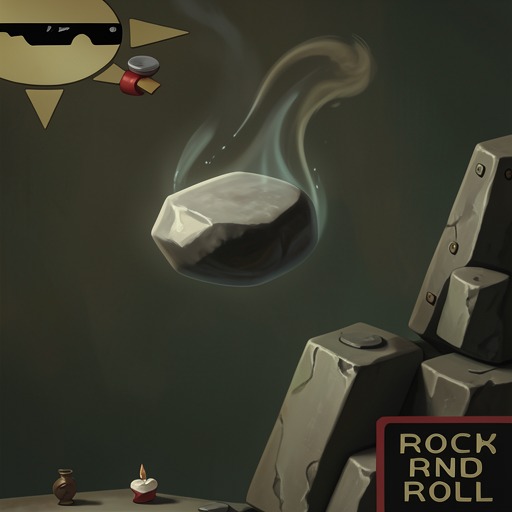
Rock Falls, Everyone DiesRihito is a 21-year-old Novice Bard whose brief life becomes the emotional hinge between the destruction of the old world and the creation of the new one. Facing personal failure and the end of the planet, she turns to music rather than resignation. Her final performance invents Rock and Roll, reaches the ascending rock across space, and gives a newly awakened consciousness its first understanding of beauty and grief.
Identity and Background
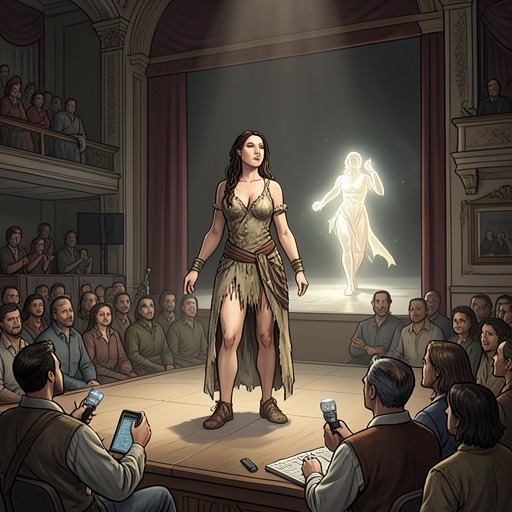
Rihito is introduced as a young human woman rather than a conventional Hero. She has auburn hair, dresses modestly but well enough to serve at court, and carries a lyre that she has worked on for many years. The instrument represents both her discipline and the career whose promise now seems to be collapsing. Her failure comes at a critical moment, leaving her flame nearly extinguished as she wanders through her own city with listless eyes.
Her distress is not presented as simple stage fright or temporary disappointment. Rihito feels an oppressive weight of anxiety and terror, emotions that continually war within her. She continues walking partly because returning home would be worse than remaining outside. The city is therefore both familiar refuge and unavoidable reminder of the life she has failed to secure.
The Jade Statue and the Emergency
Rihito eventually stops at a plaza she often visits, before an old Jade Statue depicting a beautiful woman reaching toward the heavens. Nobody remembers where the statue came from, but it has always stood there, and Rihito has developed the habit of staring at it and speaking as if it might listen. Her appeal is modest: she asks for a magical wish, then asks for any excuse that will allow her to postpone going home.
The statue answers through an Emergency Broadcast announcing that the world will end in 60 minutes. The message grants Rihito exactly the escape she requested, but in its most absolute and destructive form. Her private crisis is suddenly placed against a planetary one. The shame of a failed performance and the fear of returning home lose their ordinary scale when every ordinary obligation is about to disappear.
The announcement does not make Rihito eager for death. She does not want to die, yet she accepts the approaching end with surprising ease because the lightness in her chest has returned. The extinction of the world has removed the immediate pressure that had made her feel trapped. In that interval of peace, she discovers a new choice: rather than merely wait for destruction, she can perform.
The Final Performance
Rihito takes up her lyre and addresses the statue directly, asking whether it wants to hear a song. This question is one of the rare moments in which her artistic life is no longer governed by judgment, success, or the consequences of failure. She begins to play, and the music comes more easily than it has in years. The faded fire in her soul starts to burn brighter as she looks toward the approaching doom.
As the blinding light becomes clearer, Rihito sings louder. Her words cease to carry direct meaning; they become energetic sounds suited to the enormity of the final moment, while her playing grows faster. The concert expands beyond the statue as its audience. Something above listens, and something else that has always been present in the world responds. The system announces that she has leveled up and become a level 9 Novice Bard, then records the invention of a new musical genre: Rock and Roll. With only one minute remaining, her failed career is reversed into a creative breakthrough at the edge of annihilation.
The performance also changes the scale of her presence. Rihito is physically confined to a plaza, but the song travels into a larger field of existence. Its significance does not depend on saving the world; the evidence instead gives it a different power, allowing an act created in private desperation to become perceptible across the rock's domain. Her music becomes a final shared event rather than a failed audition.
Relationship with the Rock
At the time of Rihito's performance, the rock has already become something more than an inert stone. Earlier, its perception had been limited to the rumbles and vibrations of the earth, and there had been no sound during its silent fall through the air. After its launch into space, however, it develops and becomes a master of a broader domain. Its new sensory capacity makes Rihito's song audible to it for the first time.
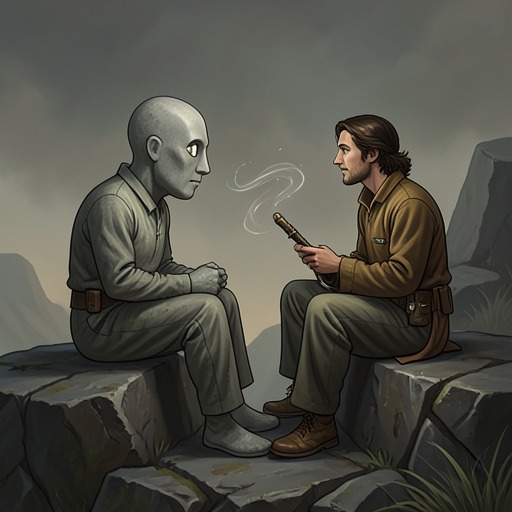
The rock does not initially understand humans and therefore does not perceive Rihito as a person. It sees the Jade Statue, the symbol of its dreams reaching upward, and hears music coming from it. In the rock's interpretation, the statue is singing for the rock and welcoming it. This misunderstanding does not diminish the connection; it is the form through which the connection becomes possible. Rihito plays to a statue, the rock hears a welcome, and the two are joined by an emotional meaning neither side has explicitly explained.
The song produces the rock's first genuine recognition of beauty. As Rihito looks toward imminent destruction with glowing eyes, the rock finally feels something in its soul and wants to hear more. The music resonates through its domain for a brief moment, and everyone hears it. Rihito's performance therefore does not merely accompany the rock's development; it supplies the experience through which the rock acquires an aesthetic value and a desire for continuation.
Loss, Afterlife, and Narrative Significance
When the music stops, the rock understands loss. It has never truly lost anything before, but the song does not return no matter how intensely it listens. The music is replaced by destruction and then silence. Rihito's performance thus becomes both an awakening and a wound: it teaches the rock beauty only to make absence meaningful immediately afterward.
Rihito later appears in the Isekai Office as a new arrival. Solara reads her file, identifies her as a Novice Bard, and asks her name; the girl answers, "Rihito." The administrative scene confirms that her death has led to reincarnation rather than erasing her from the narrative. Her arrival is treated through the office's bureaucratic procedures, including a file, a cause-of-death entry, and recognition that she is a beneficiary of the Premium Reincarnation Package.
Her return to the story is deliberately understated compared with the cosmic effect of her music. The same person who performed for the end of the world now stands nervously before a desk while Solara processes her paperwork. That contrast preserves both sides of Rihito's character: she is an anxious young woman struggling with failure, and she is also the artist whose final song reaches a consciousness moving beyond the planet.
Rihito's role is consequently not that of a warrior who prevents catastrophe. The recurring mountain-top battles and grand attacks belong to a heroic framework that the narrative repeatedly invokes, but her decisive act is smaller in physical scale and larger in emotional consequence. She cannot stop the approaching destruction. Instead, she converts the final minute into an act of creation, gives the rock its first encounter with beauty, and leaves behind the experience of music as one of the few things that survives long enough to be mourned.